Analysis of End Mill Types: Tungsten Carbide End Mills vs. Indexable End Mills
As tungsten carbide prices continue to surge, many buyer have started shifting from tungsten carbide end mills to indexable end mills in an effort to reduce machining costs by replacing only the inserts instead of the entire tool.
Although the cost of tungsten carbide end mills has increased significantly, their stability and cutting performance still outperform indexable end mills in many machining applications. In this article, we provide an objective comparison of these two end mill types, helping you choose the most suitable tooling solution based on your actual machining requirements.
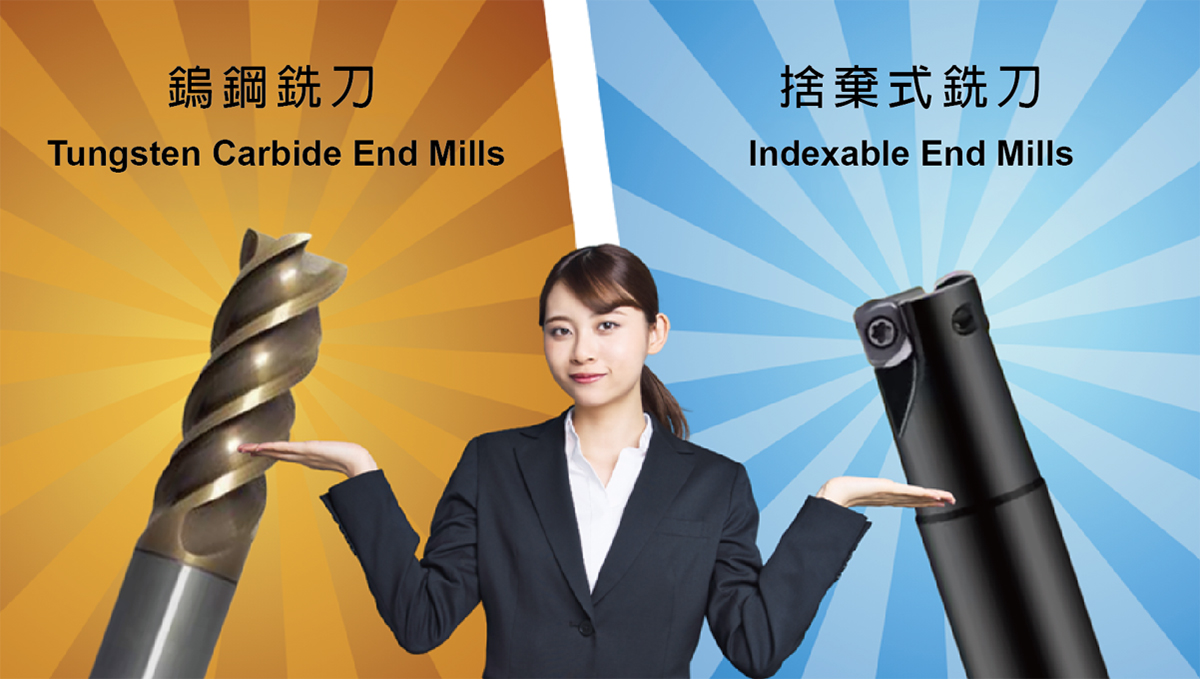
Quick Guide to the Differences Between Tungsten Carbide End Mills and Indexable End Mills
The biggest difference between tungsten carbide end mills and indexable end mills lies in their structural design. Tungsten carbide end mills feature a solid one-piece construction, while indexable end mills consist of a tool holder combined with replaceable carbide inserts.
indexable end mills consist of a tool holder combined with replaceable carbide inserts. Therefore, when evaluating these two tooling options, it is important not only to compare their purchase prices, but also to consider three key factors: tool rigidity and runout accuracy, cutting resistance and chip evacuation performance, as well as machining flexibility and versatility. These aspects will help determine which type of end mill best matches your production needs.
Key Differences Between Tungsten Carbide End Mills and Indexable End Mills
Tool Rigidity and Runout Accuracy
- Tungsten carbide end mills: Manufactured from a single solid material and precision-ground as one piece, providing excellent rigidity and minimal radial runout during operation.
- Indexable end mills: Due to the assembly gap between the insert and tool holder, cumulative runout tends to increase during high-speed or heavy-duty cutting applications.
Cutting Resistance and Chip Evacuation
- Tungsten carbide end mills: Extremely sharp cutting edges and smooth flute geometry reduce cutting resistance and minimize chip clogging issues.
- Indexable end mills: Because of insert pressing processes and strength requirements, inserts are commonly designed with negative rake angles to prevent edge chipping, resulting in higher cutting resistance and more limited chip evacuation space.
Machining Flexibility and Versatility
- Tungsten carbide end mills: Available in a wide range of diameters, making them ideal for deep slots, intricate contours, and precision finishing applications.
- Indexable end mills: Limited by insert screws and pocket structures, they are generally larger in diameter and mainly suitable for large-area machining, roughing, and face milling operations.
Cost Comparison: Tungsten Carbide End Mills vs. Indexable End Mills
| Comparison Item | Tungsten Carbide End Mills | Indexable End Mills |
|---|---|---|
| Initial Investment Cost | Moderate. As tungsten carbide raw material prices fluctuate, the purchase cost of each tool can rise significantly. However, no additional accessories or holders are required. | High. Initial setup requires dedicated steel tool holders or cutter bodies, which are considered fixed asset investments and result in higher upfront costs. |
| Long-Term Consumable Cost | High. Once the tool becomes worn or chipped, the entire cutter must be replaced or sent for regrinding, leading to additional maintenance expenses. | Low. Worn inserts can simply be rotated to a new cutting edge or replaced with inexpensive inserts, while the tool holder itself remains reusable. |
| Tool Service Life | Service life depends on the number of regrinds and the amount of material removed during regrinding. Although regrinding can extend usability, the overall cutting life gradually decreases as the tool diameter becomes smaller. | The tool holder itself has a long service life, while the inserts wear relatively quickly. Under proper operating conditions, the holder offers excellent durability, though attention should be paid to insert pocket deformation and screw wear over time. |
Machining Performance Comparison: Tungsten Carbide End Mills vs. Indexable End Mills
| Comparison Item | Tungsten Carbide End Mills | Indexable End Mills |
|---|---|---|
| Machining Application Positioning | Suitable for roughing, semi-finishing, high-speed roughing, and finishing operations, making them highly versatile all-purpose cutting tools. | Primarily used for large-area face milling, heavy roughing, and high-feed machining applications. |
| Surface Finish (Ra) | With minimal runout and sharp cutting edges, they produce excellent surface brightness and superior finishing quality. | Due to assembly runout and higher cutting resistance, tool marks are more likely to remain on the workpiece surface, often requiring additional finishing allowance. |
| Axial Depth of Cut (Ap) | The solid structure provides excellent rigidity, enabling full flute-depth side milling and heavy axial cutting. | Restricted by insert structure and radial force distribution, they are generally not suitable for excessively deep axial cuts. |
| Feed per Tooth (Fz) / Feed Rate (F) | Moderate feed rates, primarily relying on high spindle speeds and multiple flutes to maintain material removal efficiency. | Extremely high feed capability. Specialized high-feed geometries allow the inserts to withstand substantial per-tooth impact loads and aggressive table feed rates. |
Real-World Performance Test of Different End Mill Types
HD. conducted a real-world machining test comparing its proprietary tungsten carbide end mill (2MHD1004TXM) against a commercially available indexable end mill. The evaluation focused on machining efficiency when cutting a commonly used difficult-to-machine material: 2714 hot-work tool steel.
The test results showed that the HD. tungsten carbide end mill, benefiting from superior overall rigidity, was capable of directly performing a 10 mm axial depth of cut in a single pass, reducing the total machining time to only 1 minute and 17 seconds.
In contrast, although the commercial indexable end mill demonstrated several times higher feed per tooth performance (reaching 0.15 mm in the test), its structural rigidity limitations required a 0.3 mm layer-by-layer high-speed milling strategy. As a result, machining the same workpiece took more than 11 minutes to complete.
These results clearly demonstrate the significant efficiency advantages of tungsten carbide end mills in deep-cut machining applications.
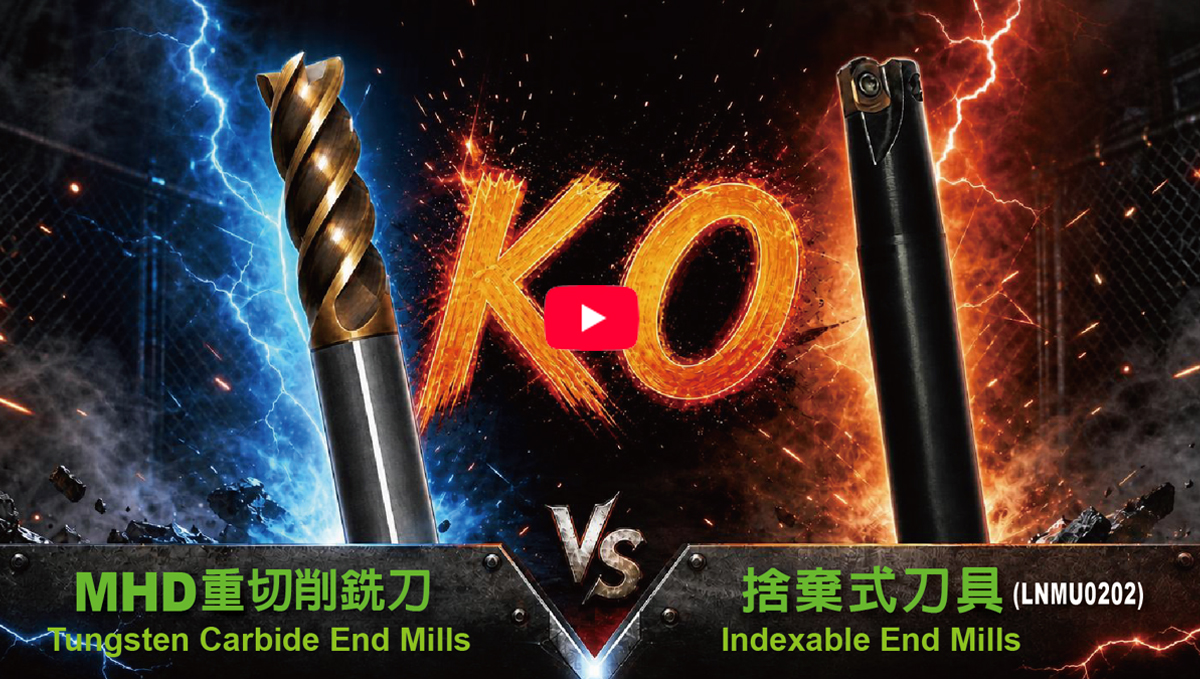
From the test footage, it is evident that while indexable inserts may offer lower consumable costs per replacement, forcing indexable tooling into roughing or precision finishing applications where it is not ideally suited can severely reduce production efficiency and create substantial hidden time costs.
Therefore, when purchasing end mills, buyer should evaluate not only tooling consumable expenses, but also machining time and overall production efficiency. Selecting the correct cutting tool is ultimately the most effective way to reduce total manufacturing costs.


