HSS vs. Carbide for Aluminum: Which Cutting Tool Is Better?
When machining aluminum, one common question is:
Should you use HSS cutting tools or tungsten carbide end mills?
The answer depends on your machining equipment, production volume, cutting speed, accuracy requirements, and overall tooling budget.
Aluminum is generally considered easy to machine compared with many steels and superalloys. However, choosing the wrong cutting tool can still lead to built-up edge, chip evacuation problems, poor surface finish, and reduced tool life.
This article explains the characteristics of aluminum, the common challenges of aluminum machining, and the key differences between HSS end mills and tungsten carbide end mills to help you choose the right tool for your application.
What Makes Aluminum Such a Widely Used Material?
Aluminum is one of the most commonly used metals in industrial manufacturing and everyday products. Its combination of low weight, corrosion resistance, thermal conductivity, and excellent machinability makes it suitable for a wide range of applications.
1. Lightweight
Aluminum has a relatively low density, making it ideal for products where weight reduction is important, such as:
- Aerospace components
- Automotive parts
- Bicycle components
- Electronic products
- Transportation equipment
2. Excellent Corrosion Resistance
Aluminum naturally forms a thin oxide layer on its surface, helping protect the underlying material from corrosion.
3. Good Electrical and Thermal Conductivity
Aluminum offers approximately 60% of the electrical conductivity of copper while being significantly lighter. It is commonly used in electrical cables, heat sinks, radiators, and electronic components.
4. Excellent Machinability
Aluminum can be easily machined, bent, stamped, extruded, and welded. These characteristics allow manufacturers to produce complex shapes and precision components efficiently.
5. Highly Recyclable
Recycling aluminum requires significantly less energy than producing primary aluminum, making it an important material for energy-efficient and sustainable manufacturing.
6. Attractive Surface Finishing Options
Aluminum can be anodized, sandblasted, polished, painted, or treated with other surface finishing processes to improve appearance, wear resistance, and product durability.
What Are the Main Challenges of Aluminum Machining?
Although aluminum is relatively easy to cut, it presents several machining challenges.
1. Built-Up Edge
Aluminum can adhere to the cutting edge and form a built-up edge. This may cause
- Rough surface finishes
- Scratches or deformation
- Dimensional inaccuracies
- Increased risk of cutting-edge chipping
2. Heat Generation During High-Speed Machining
Aluminum has excellent thermal conductivity, but high-speed machining can still generate significant heat in the cutting zone. Excessive heat may affect tool life and machining stability.
3. Chip Evacuation
Aluminum chips can be relatively large and may become tangled during machining. Poor chip evacuation can lead to chip recutting, surface damage, and unstable cutting performance.
4. Incorrect Tool Selection
Using cutting tools designed primarily for steel can increase the risk of material adhesion, poor chip evacuation, and reduced surface quality when machining aluminum.
How Can You Improve Aluminum Machining Performance?
Several practical measures can help improve machining efficiency and tool life when cutting aluminum.
Use Highly Polished Cutting Tools
Aluminum-specific cutting tools often feature polished flutes and sharp cutting edges. These designs reduce friction and help prevent aluminum chips from sticking to the tool.
Use Appropriate Cutting Fluids
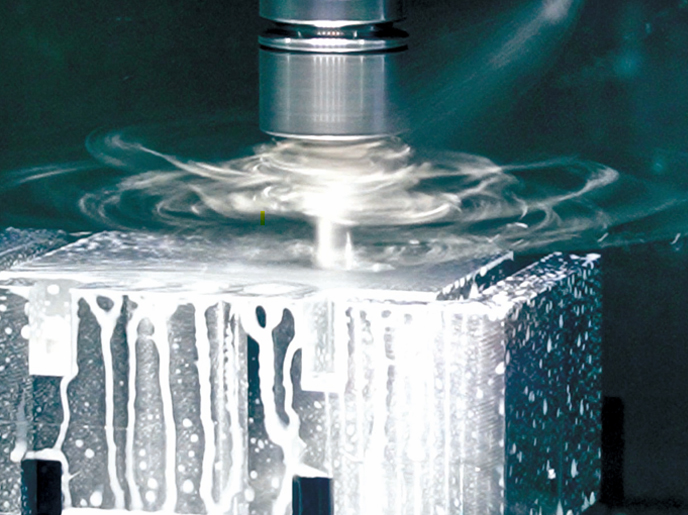
Proper cutting fluid can reduce friction between the cutting tool and workpiece, control cutting temperature, and minimize material adhesion.
Optimize Cutting Parameters
Cutting speed, feed rate, and depth of cut should be adjusted according to the aluminum grade, machine rigidity, tool geometry, and machining requirements.
The goal is to achieve a balance between productivity, surface quality, and tool life.
HSS End Mills vs. Tungsten Carbide End Mills for Aluminum
| Comparison | HSS End Mills | Tungsten Carbide End Mills |
|---|---|---|
| Cutting Speed | Best suited for low to medium cutting speeds | Suitable for high-speed machining |
| Tool Cost | Lower initial cost | Higher initial investment |
| Wear Resistance | Moderate | Excellent |
| Toughness | Higher toughness and better resistance to sudden impact | Higher hardness but relatively more brittle |
| Machining Accuracy | Suitable for general machining | Ideal for high-precision applications |
| Production Volume | Suitable for small batches and occasional machining | Suitable for continuous and automated production |
| Recommended Applications | Conventional milling, prototyping, repair work, budget-snesitive applications | CNC machining, high-speed cutting, mass production, precision machining |
When Should You Choose HSS End Mills for Aluminum?
HSS end mills can be a practical and cost-effective choice when cutting aluminum at low to medium speeds.
They are particularly suitable for:
- Conventional milling machines
- Small-batch production
- Prototype machining
- Maintenance and repair work
- Applications with limited tooling budgets
- Machines with lower spindle speeds
If high-speed machining and extreme accuracy are not required, HSS end mills can provide reliable performance at a relatively low initial cost.
When Should You Choose Tungsten Carbide End Mills for Aluminum?
Tungsten carbide end mills are generally the better choice for high-speed, high-precision, and continuous aluminum machining.
Their high hardness and excellent wear resistance allow them to maintain sharp cutting edges under demanding machining conditions.
They are particularly suitable for:
- CNC machining centers
- High-speed machining
- Automated production lines
- Long production runs
- High-precision components
- Applications requiring excellent surface finishes
Although tungsten carbide end mills have a higher initial cost and are more brittle than HSS tools, their longer tool life and higher machining efficiency can often provide a lower total machining cost in high-volume production.
HSS or Tungsten Carbide: Which Is Better for Machining Aluminum?
There is no single cutting tool that is best for every aluminum machining application.
Choose HSS end mills if you need:
- Lower initial tooling costs
- Better toughness
- Conventional machining compatibility
- Small-batch or repair machining
Choose tungsten carbide end mills if you need:
- Higher cutting speeds
- Better dimensional accuracy
- Longer tool life
- Improved wear resistance
- Stable performance for continuous production
For general, low-speed, or budget-sensitive aluminum machining, HSS end mills can provide excellent value.
For CNC machining, automated production, high-speed cutting, and precision applications, tungsten carbide end mills are usually the more efficient long-term solution.
The key is not simply choosing the most expensive cutting tool, but selecting the right tool based on your machine capability, aluminum material, production volume, cutting parameters, and required surface quality.


